

You know that feeling where someone’s talking to you, you’re looking right at them, nodding along, and somewhere around the third sentence your brain just… leaves? Not on purpose. It just quietly clocks out and you’re left nodding at nothing, hoping they don’t ask a follow up question you can’t answer.
Or the classic one. You walk into a room to get something specific. By the time you’re standing in the middle of it, the reason you came in has evaporated completely. You stand there for a second, genuinely baffled, before either remembering or just giving up and walking back out.
If you’ve got ADHD, none of this is new information. It’s just tiring information, the kind that makes you wonder why something that looks so easy for other people, focus, remember, think clearly, feels like your brain is running through wet sand most days.
There’s a name a lot of people use for this. Brain fog. It’s not a medical term on its own, but it describes something very real, and once you understand what’s actually happening, it stops feeling like a personal failing and starts making a lot more sense.
The Note in Brief
ADHD brain fog is the mental cloudiness, forgetfulness, and trouble focusing that a lot of people with ADHD deal with regularly. It isn’t a clinical diagnosis on its own. It’s a real, recognizable cluster of symptoms that usually comes from a mix of things: how ADHD brains handle attention and dopamine, plus everyday factors like poor sleep, stress, and mental overload that make it noticeably worse. It’s not permanent and it’s not a character flaw. There are specific things that help, and we’re going to walk through all of it simply.
Key Takeaways
- ADHD brain fog isn’t laziness. It’s a real experience with real causes, tied to how ADHD brains manage attention, dopamine, and mental load.
- It usually shows up as trouble concentrating, losing your train of thought, forgetfulness, and a kind of mental slowness that makes even simple things feel harder than they should.
- Common triggers include mental overload, decision fatigue, emotional stress, poor sleep, and the exhaustion of masking symptoms to get through the day.
- If it’s constant or getting worse, that’s worth a real conversation with a doctor, not something to just push through alone.
ADHD Brain Fog Symptoms: What It Actually Feels Like
Brain fog isn’t one single symptom. It’s a handful of smaller, annoying ones that tend to show up together, and most people don’t realize they’re all connected until someone actually lists them out. Here’s what it commonly looks like day to day.
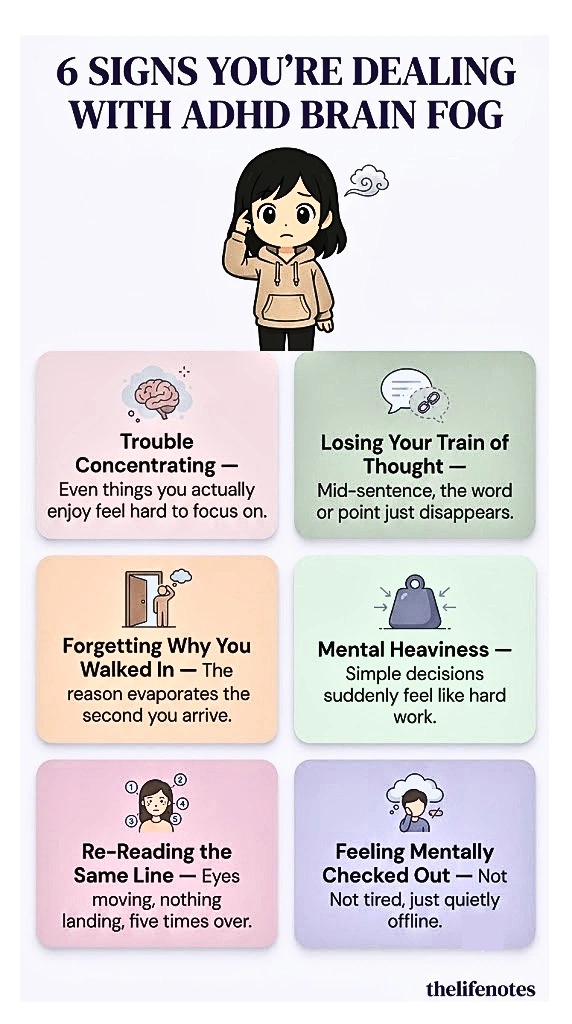
Trouble concentrating, even on things you actually care about. Not just boring tasks. Sometimes even a show you’re excited to watch or a book you chose yourself.
Losing your train of thought mid-sentence. You’re talking, and then the word or the point you were making just isn’t there anymore. You either trail off or fumble around trying to find it again.
Forgetting why you walked into a room, or what you were just doing. This one happens constantly and it’s rarely about actual memory loss. It’s more like your brain switched tabs without saving your place.
A kind of mental slowness or heaviness. Thoughts that would normally come quickly feel like they’re moving through something thick. Simple decisions, what to eat, what to wear, feel weirdly hard.
Reading the same sentence or paragraph multiple times. Your eyes move across the words. Nothing lands. You get to the end with zero memory of what you just read.
Feeling mentally “checked out” even when you’re not tired. This is different from sleepiness. It’s more like your brain has quietly gone offline while your body’s still sitting there.
None of this means you’re less capable or less intelligent. It means your brain is genuinely working harder behind the scenes than it looks like from the outside, and eventually that shows up as fog.
Join the Notes
Join The Life Notes for practical ideas about mental wellness, productivity, relationships, and everyday life, without toxic positivity or productivity guilt.
Pause & Reflect
Think about the last few times brain fog hit hardest. Was it after a stretch of poor sleep, a stressful day, too many decisions, or none of the above?
Naming your actual pattern is more useful than any generic tip, because your fog probably has a shape, even if you’ve never mapped it before.
What Causes ADHD Brain Fog
Brain fog doesn’t come out of nowhere. There are a handful of real, recognizable reasons it shows up, and most people with ADHD deal with more than one of these at once.
Mental overload.
ADHD brains tend to take in more at once, sounds, thoughts, notifications, half-finished ideas, all competing for the same limited attention. When there’s too much coming in, your brain doesn’t calmly filter it out. It slows down, freezes, or just checks out entirely. That shutdown isn’t weakness. It’s closer to a circuit breaker tripping because too much hit it at once.
Decision fatigue.
Small decisions take more effort for ADHD brains than people realize, because organizing and prioritizing don’t come as automatically. String enough tiny decisions together across a day, what to answer first, what to eat, what to do next, and by afternoon there’s genuinely less left in the tank for clear thinking.
Emotional overwhelm.
ADHD affects emotional regulation just as much as attention. A hard conversation, a missed deadline, feeling criticized, any of it can drain mental clarity fast, because your brain is spending resources managing the feeling instead of thinking clearly.
Poor sleep.
Sleep issues are extremely common with ADHD, and even a rough night or two noticeably worsens focus, memory, and mood the next day. This becomes a loop pretty fast: ADHD makes good sleep harder to get, and bad sleep makes ADHD symptoms, including fog, considerably worse.
Burnout from masking.
A lot of adults with ADHD spend real energy all day trying to appear organized, on top of things, and unaffected, even when they’re struggling underneath. That performance is exhausting, and eventually the brain runs low on fuel. Fog is often what’s left when the tank hits empty.
Other things layered on top.
Anxiety, low mood, thyroid issues, dehydration, and stress can all worsen brain fog on their own, and they’re common alongside ADHD. If fog feels unusually severe, sudden, or different from your normal, it’s worth ruling these out with a doctor rather than assuming it’s just ADHD.
What Actually Help Clear ADHD Brain Fog
None of these are a cure, and nobody’s pretending willpower was ever the missing piece. What actually helps is reducing how much your brain has to juggle at once, and treating the basics as real strategy instead of optional extras.
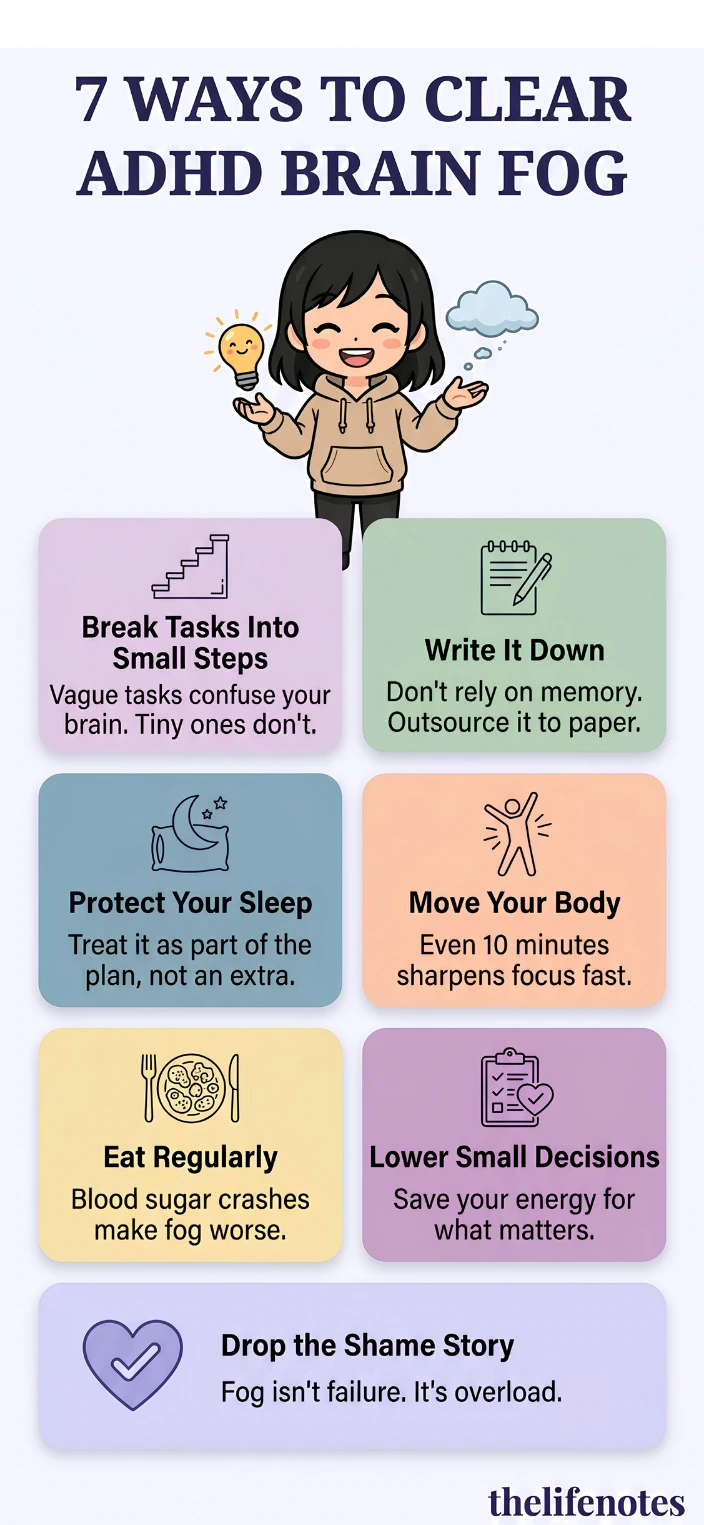
- Break tasks into smaller, specific steps. Vague tasks keep your brain unsure where to even begin. A clear, tiny first step gives it somewhere real to land.
- Write things down instead of trying to hold them in your head. Lists, sticky notes, reminders in plain sight. This isn’t cheating. It’s outsourcing the part of the job your brain genuinely struggles with.
- Protect your sleep like it’s part of the treatment plan, because it is. A consistent bedtime and less screen time right before sleep does more for next-day clarity than most people expect.
- Move your body, even briefly. Ten to twenty minutes of movement genuinely boosts the same brain chemicals ADHD affects, and the difference in focus afterward is often noticeable fast.
- Eat regularly and don’t skip meals. Blood sugar crashes make fog considerably worse. Something with protein earlier in the day tends to help more than people expect.
- Lower unnecessary decisions where you can. Repeating outfits, simple meal rotations, default answers for low-stakes choices. Saving your decision-making energy for things that actually matter.
- Stop reading fog as a personal failure. This one matters more than it sounds. Interpreting a foggy day as laziness adds shame on top of exhaustion, and shame doesn’t clear fog, it thickens it.
Try it today
Right now, name one task you need to do in the next hour. Say the very next physical step out loud, just one sentence, like “open my laptop” or “grab the mail.” Then do only that one step.
That’s it. Don’t plan the whole task. Just the next move
What Research Suggests
Research on ADHD points to differences in how the brain regulates attention and dopamine, specifically involving executive function and a network responsible for mind-wandering that doesn’t quiet down the way it should during focused tasks. A clinical overview from ADDA, the Attention Deficit Disorder Association, breaks this down clearly if you want to go deeper.
Sleep problems are also well documented in ADHD, affecting a large share of both children and adults, and poor sleep reliably worsens attention and mental clarity the next day in anyone, ADHD or not. Choosing Therapy has a solid, readable summary of this connection.
When to Talk to a Doctor
Occasional fog is common with ADHD and usually manageable with the strategies above. It’s worth reaching out to a doctor if brain fog is constant, getting worse, showing up alongside significant mood changes, or making it hard to function safely day to day. It’s also worth a conversation if you suspect undiagnosed ADHD and have never actually been evaluated. A proper assessment can make a real difference here, more than any self-help list ever will.
Today’s Life Note
You’ve probably spent years quietly comparing your brain to everyone else’s, like theirs came with a better antenna.
It doesn’t work that way. Your attention isn’t broken, and it isn’t weaker.
It’s just tuned differently, picking up static where other people get silence, and picking up brilliant, sudden signal where other people get nothing at all.
The goal was never to force it into someone else’s frequency. It’s to learn your own well enough to know when to lean in, and when to just wait for better reception.
Join the Notes
One honest, steady read a week on focus, overwhelm, and the parts of daily life that take more out of you than they should. No productivity guilt, just things that actually help. Subscribe below.
FAQs
Is ADHD brain fog a real diagnosis?
Not a formal one, no. It’s a widely recognized cluster of experiences, trouble focusing, forgetfulness, mental cloudiness, that’s very real even without its own diagnostic code.
What does ADHD brain fog feel like?
Most people describe it as mental heaviness or slowness, trouble concentrating even on things they care about, losing their train of thought, and forgetting things moments after thinking them.
What triggers ADHD brain fog?
Common triggers include mental overload, too many small decisions in a row, emotional stress, poor sleep, and the exhaustion of masking ADHD symptoms throughout the day.
Can ADHD medication help with brain fog?
For a lot of people, yes. Since brain fog is often tied to dopamine and attention regulation, appropriate ADHD treatment can meaningfully reduce it, though this should always be discussed with a doctor.
Is brain fog the same as being tired?
Related, but not identical. You can have brain fog without feeling physically sleepy. It’s more about mental clarity and focus than raw tiredness, though poor sleep does make it worse.
When should I be concerned about brain fog?
If it’s sudden, severe, rapidly worsening, or comes with other concerning symptoms, it’s worth seeing a doctor to rule out other causes beyond ADHD.
You Might Find These Helpful
- ADHD Task Paralysis: Why Starting Feels Impossible and How to Move Again For the moments brain fog tips over into being completely unable to start, not just unable to focus.
- What Is ADHD Time Blindness? Focus trouble and a distorted sense of time often show up together and feed each other.
- Why Am I Always Mentally Exhausted? Useful if brain fog seems to hit hardest on days you’re already running on empty.
- Why Do I Procrastinate? A closer look at the emotional side of avoidance, separate from the attention-network piece covered here.
- How to Find Balance in Life Without Feeling Overwhelmed Explore what it can look like to find balance for work, health, relationships, and yourself.
- Why Do I Overthink at Night? How to Stop Racing Thoughts and Overthinking Doomscrolling and racing thoughts often show up together at night. This note explores why your mind gets loudest right when you’re trying to wind down.
References
- ADDA, Attention Deficit Disorder Association, on ADHD brain fog and the default mode network, add.org
- Choosing Therapy, clinical overview of ADHD and brain fog, choosingtherapy.com
- National Institute of Mental Health, overview of ADHD, nimh.nih.gov
This note is for general information and isn’t a substitute for diagnosis or care from a licensed healthcare professional. If brain fog is persistent, severe, or significantly affecting your daily life, consider speaking with a doctor or ADHD specialist.