

You are sitting on the couch, or standing at your desk, fully aware of the one thing you should be doing right now.
The task might take four minutes. It might be replying to a simple message, opening a bill, or picking up a pile of clothes from the floor.
You want to finish it. You can see how much lighter you would feel if it were done. Yet your body stays still.
Hours pass while you sit near the task, accumulating physical tension and mental fatigue.
Outside observers might assume you are relaxing or putting things off.
On the inside, your brain is running at full speed, trying to locate the switch that turns intention into action.
The Note in Brief
ADHD task paralysis occurs when the brain knows a task needs to get done, yet cannot initiate the physical movement to start it. It is not a flaw in character or a lack of care. Instead, it stems from executive dysfunction, the system in the brain responsible for planning, prioritizing, and starting actions. While it can make ordinary days feel heavy, reducing friction and lowering the barrier to entry can help you move past the initial freeze.
Key Takeaways
- It’s a starter motor issue, not laziness: ADHD task paralysis is an executive dysfunction freeze that hits even when you genuinely want to start.
- Overload causes the stall: Having too many choices or vague steps triggers choice paralysis, causing your brain to freeze like a computer with thirty open tabs.
- Shrink the first physical step: Lowering your activation energy with a 2-minute timer or a single micro-step gets your body moving past the invisible wall.
- Lower the quality floor: Dropping perfectionism removes the quiet pressure that keeps you stuck, proving a messy start beats a blank page every time.
What ADHD Paralysis Actually Means
When you hear the term “ADHD paralysis,” it isn’t a formal medical term you’ll find in a diagnostic manual. It’s simply the phrase people use to describe that very real, deeply frustrating moment when your brain gets stuck.
You know exactly what you need to do, you genuinely want to do it, and you might even feel a growing wave of anxiety about putting it off. Yet, somehow, the message to actually move your body just doesn’t get through.
Think of it like a starter motor in a car that keeps clicking without turning the engine over. It has nothing to do with being lazy or not caring enough. In fact, most people dealing with this are caring too much and thinking about the task constantly.
The difficulty is just in crossing the gap between having the intention to start and taking the very first physical step.
At its core, this freeze is usually a reaction to mental overload. When a single task comes with too many steps, hidden decisions, or unspoken expectations, the brain tries to process everything all at once.
The sheer volume of that internal math causes the system to stall out, much like a laptop when you open thirty browser tabs at the same time.
What Else Is It Known As?
In clinical and psychological contexts, this experience is often described using more formal terminology. You might hear it referred to as:
- Executive Dysfunction (specifically, Task Initiation Deficit): This is the precise umbrella term, identifying it as a failure of the brain’s “command center” to launch an action.
- Decisional Paralysis: Often used when the freeze is caused by choice overload (the third type, as we will discuss below).
- ADHD “Freeze” Response: Highlighting it as a stress/nervous system reaction rather than a simple productivity failure.
What It Feels Like in Daily Life
Task freeze rarely looks dramatic from the outside. More often, it shows up in mundane, quietly frustrating ways:
- Opening a document, looking at a blank line, closing it, and opening it again 15 minutes later.
- Needing to make a phone call, but spending an hour deciding whether to draft notes first.
- Sitting on the edge of the bed with your shoes in hand, staring at the wall while time ticks away.
- Getting stuck in a loop of micro-tasks, like sorting pens or clearing desktop tabs, to avoid the primary obligation.
The scale of the project rarely determines the severity of the freeze. A massive report can cause it, but so can taking out the trash. Small tasks can feel even harder because logic tells you they should be easy, which adds a layer of quiet confusion to the friction.
Pause & Reflect
When you notice yourself stuck today, ask one simple question: Is this task unclear, or is it just heavy?
If it is unclear, you need information. If it is heavy, you need a smaller starting point.
The Three Types of ADHD Paralysis
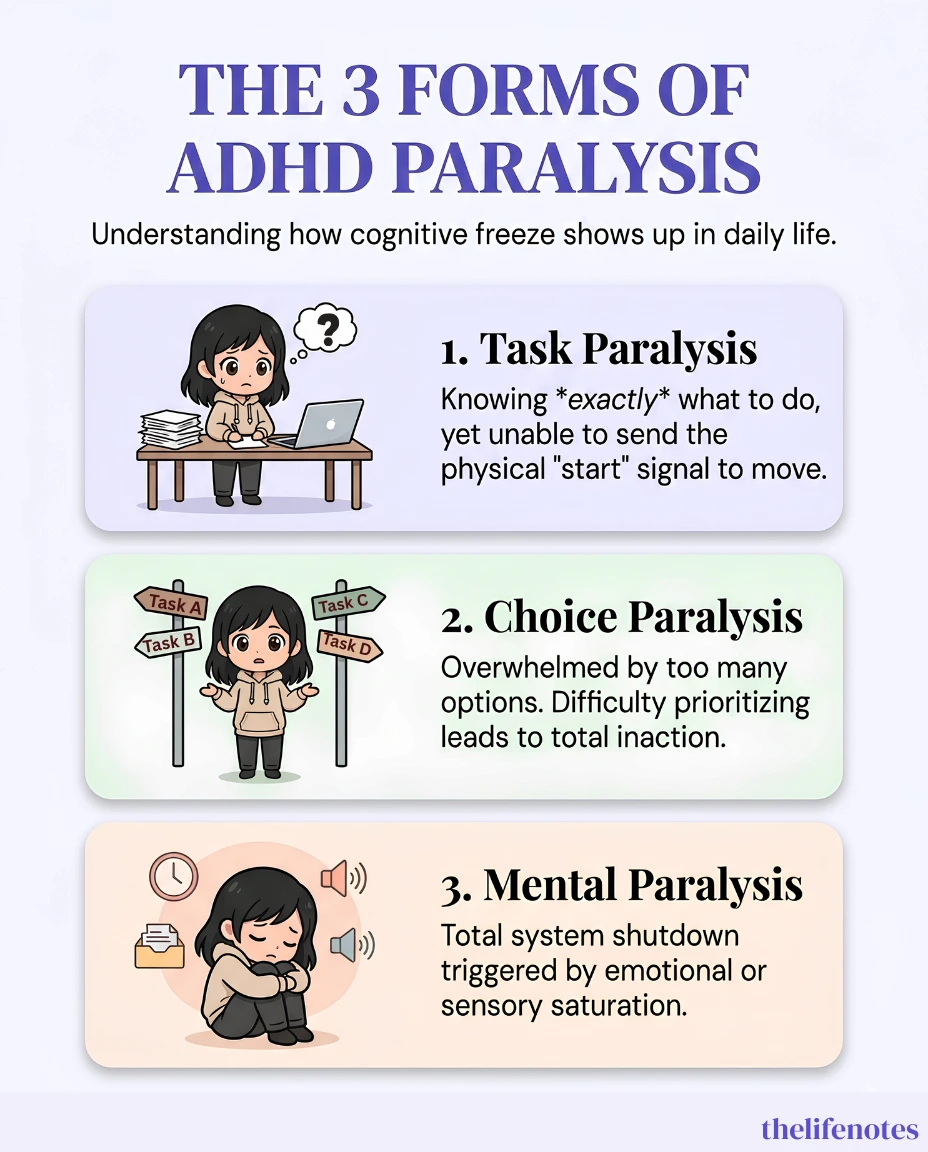
ADHD paralysis tends to manifest in three distinct forms, depending on what part of your mental system is currently overloaded:
1. Task Paralysis
This occurs when you are faced with a specific action but cannot bridge the gap between thinking about it and doing it. You know what needs to happen, but your brain cannot send the signal to begin.
2. Choice Paralysis
This happens when you face too many options at once. When six different items require attention, the brain struggles to rank their importance. Without a clear hierarchy, every task competes for first place, resulting in total inaction.
3. Mental (or Freeze) Paralysis
This is a broader nervous system response brought on by sensory or emotional saturation. When inputs become too intense, processing slows down entirely. You might struggle to speak clearly, process spoken words, or decide where to walk next.
Why It Happens: The Brain’s Starter Motor
Task initiation relies heavily on executive functions, which are managed primarily in the prefrontal cortex. This region coordinates planning, working memory, and impulse regulation.
In ADHD, executive function signals do not always transmit smoothly. Think of task initiation as an engine’s starter motor. In a neurotypical brain, turning the key generates an instant spark. In an ADHD brain, the key turns, but the engine sputters before catching.
Dopamine regulation plays a fundamental role here. Dopamine is a neurotransmitter that acts as the brain’s currency for motivation and prospective reward. When a task lacks inherent novelty, urgency, or immediate engagement, the brain struggles to allocate the necessary activation energy. Importance alone is rarely enough to bridge that gap.
What Research Suggests
Studies on adult ADHD continuously highlight executive dysfunction as a core contributor to daily challenges. According to resources from the Attention Deficit Disorder Association (ADDA), difficulties with task initiation affect daily productivity, employment stability, and emotional regulation far more consistently than physical hyperactivity.
Furthermore, clinical reviews compiled by CHADD note that structural differences in prefrontal networks alter how time and priority are perceived, confirming that task freeze stems from brain signaling rather than personal effort.
ADHD Paralysis vs. Procrastination
It is easy to lump task freeze together with procrastination, but their internal mechanisms differ significantly:
| Feature | Classic Procrastination | ADHD Task Paralysis |
| Primary Driver | Delaying a task to avoid boredom or discomfort | A breakdown in cognitive task initiation |
| Internal State | Often enjoying a distraction in the moment | Experiencing internal strain while staying near the task |
| Clarity | Clear choice to put off work until later | Strong desire to start, but unable to trigger movement |
| Response to Pressure | Often resolves when pressure increases | Can worsen as pressure and overwhelm rise |
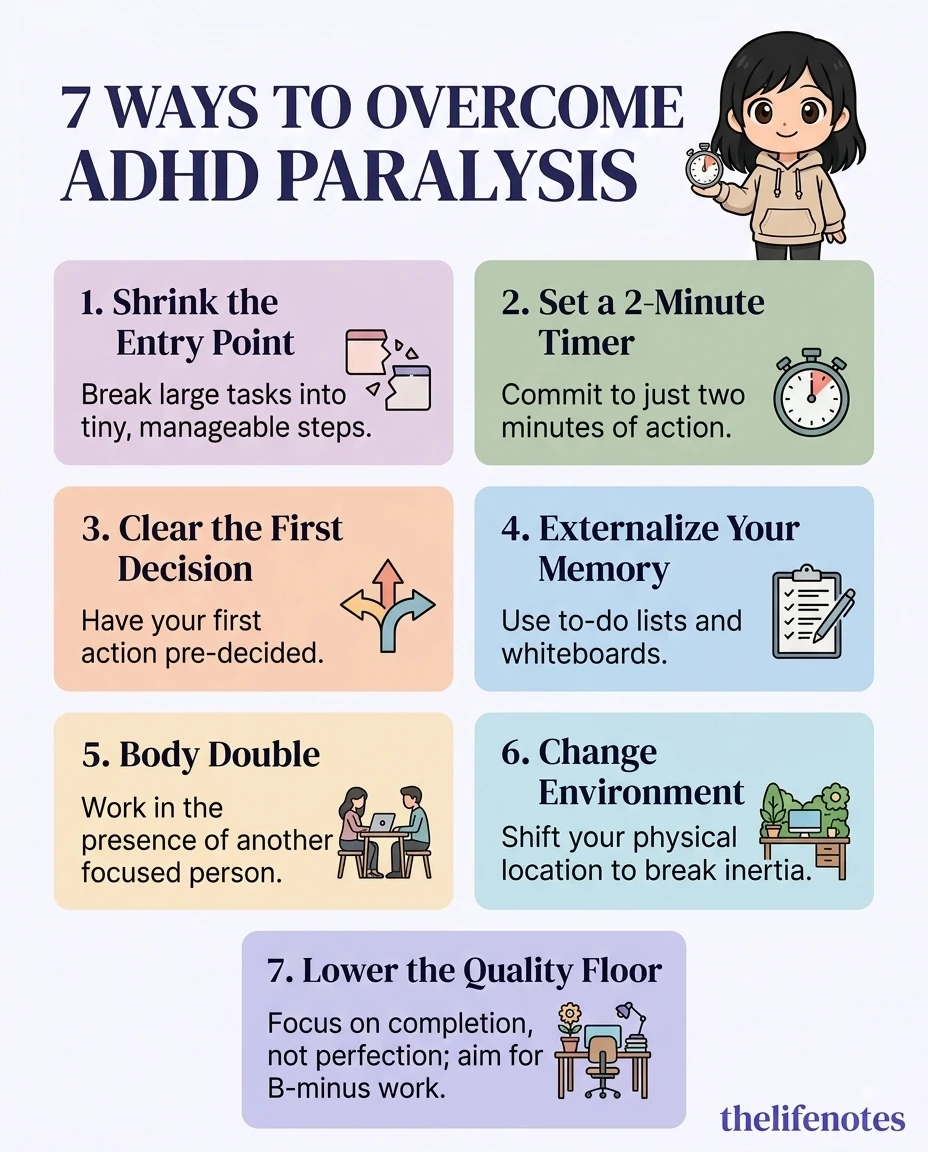
7 Practical Ways to Overcome ADHD Paralysis
When your internal starter motor is stalling, relying on willpower alone rarely works. Instead, build external ramps that lower the energy needed to take action.
1. Shrink the Entry Point
Do not break the task into logical steps; break it into physical micro-steps. If writing an email feels impossible, make the goal simply opening your browser. If clearing the desk feels too large, pick up one piece of paper. The target is movement, not completion.
2. Set an Abnormally Short Timer
Commit to working for two minutes with explicit permission to stop when the timer rings. Starting requires significant activation energy, but continuing requires far less. Giving yourself a clean exit strategy reduces the psychological threat of the task.
3. Clear the First Decision
Choice paralysis thrives on ambiguity. If you sit down to work and ask, “What should I do first?”, you add an extra layer of friction. Decide the exact initial physical movement the night before or write it on a sticky note.
4. Externalize Your Working Memory
When four tasks linger in your head, they tangle together. Dump every floating thought onto a blank sheet of paper. Once your thoughts are visible outside your mind, pick one item and cover the rest of the list with a second card.
5. Body Double
Working alongside another person creates passive accountability. You do not need to work on the same project. Sitting in the same room with a friend or joining a silent virtual working group can provide the subtle external anchor your brain needs to stay grounded.
6. Change Your Physical Environment
When frozen, your brain pairs the immediate physical space with a feeling of stuckness. Standing up, stepping into another room, opening a window, or washing your hands in cold water can reset your sensory baseline and disrupt the freeze loop.
7. Lower the Quality Floor
Perfectionism often fuels paralysis. When a task feels high-stakes, the fear of doing it poorly prevents you from starting at all. Give yourself full permission to produce a terrible first draft or do a half-hearted job. A messy start can easily be edited; a blank page cannot.
Try it today
Select one task that has been lingering on your desk or mind today.
Open the file or step toward the area where it lives. Set a timer for 90 seconds. Perform the single smallest physical action attached to it. When the 90 seconds are up, give yourself full permission to walk away.
Notice how your body feels once the initial barrier has been crossed.
When to Consider Professional Help
If task paralysis regularly interferes with your employment, financial health, or personal relationships, it is worth discussing with a professional. An accurate assessment from a licensed physician, psychiatrist, or clinical psychologist can help clarify whether ADHD or executive function challenges are present.
Working with an ADHD-informed coach or therapist can also help you build customized systems tailored to your specific cognitive patterns.
Today’s Life Note
Being stuck is exhausting, but spending energy being angry at yourself for being stuck is twice as draining.
When you cannot move forward, stop trying to force a massive leap.
Make the next step so ridiculously small that your brain has no reason to resist it.
Join the Notes
Receive one clear, grounded note each week on focus, overwhelm, and navigating modern daily life. No fluff or productivity guilt—just straightforward ideas that work.
Frequently Asked Questions
Is ADHD paralysis a formal medical diagnosis?
No. ADHD paralysis is an informal term used by clinicians, therapists, and adults with ADHD to describe task initiation failure and cognitive freeze caused by underlying executive dysfunction.
Why can I hyperfocus on hobbies but freeze on simple daily chores?
Hyperfocus is driven by novelty, interest, and immediate feedback, which naturally raise dopamine engagement in the brain. Mundane chores lack these innate triggers, making it difficult to recruit the activation energy required to start.
Can non-ADHD individuals experience task paralysis?
Yes. Severe stress, burnout, depression, anxiety, and sleep deprivation can impair prefrontal cortex functioning, leading to similar task initiation blocks in neurotypical individuals.
You Might Find These Helpful
What Is ADHD Time Blindness? -How altered time perception impacts deadlines and daily schedules.
Why Do I Procrastinate Even When I Want to Get Things Done?
A closer look at why important tasks can stay untouched until the pressure becomes impossible to ignore.
How to Stop Feeling Overwhelmed
For those days when every task seems urgent and your brain can’t decide where to begin.
Why Am I Always Mentally Exhausted?
Because managing attention, decisions, responsibilities and everyday life can take more energy than it appears to from the outside.
Why Do I Overthink at Night? How to Stop Racing Thoughts and Overthinking Doomscrolling and racing thoughts often show up together at night. This note explores why your mind gets loudest right when you’re trying to wind down.
References
- Attention Deficit Disorder Association (ADDA). Understanding Executive Dysfunction and Task Initiation in Adult ADHD. add.org
- CHADD (Children and Adults with Attention-Deficit/Hyperactivity Disorder). The Science of ADHD and Executive Function. chadd.org
- National Institute of Mental Health (NIMH). Attention-Deficit/Hyperactivity Disorder in Adults: What You Need to Know. nimh.nih.gov
This note is provided for educational and informational purposes only and is not a substitute for professional medical advice, diagnosis, or treatment.
Pingback: ADHD Career Fit: What Career Is Right for Me? (A Realistic Guide) - thelifenotes