
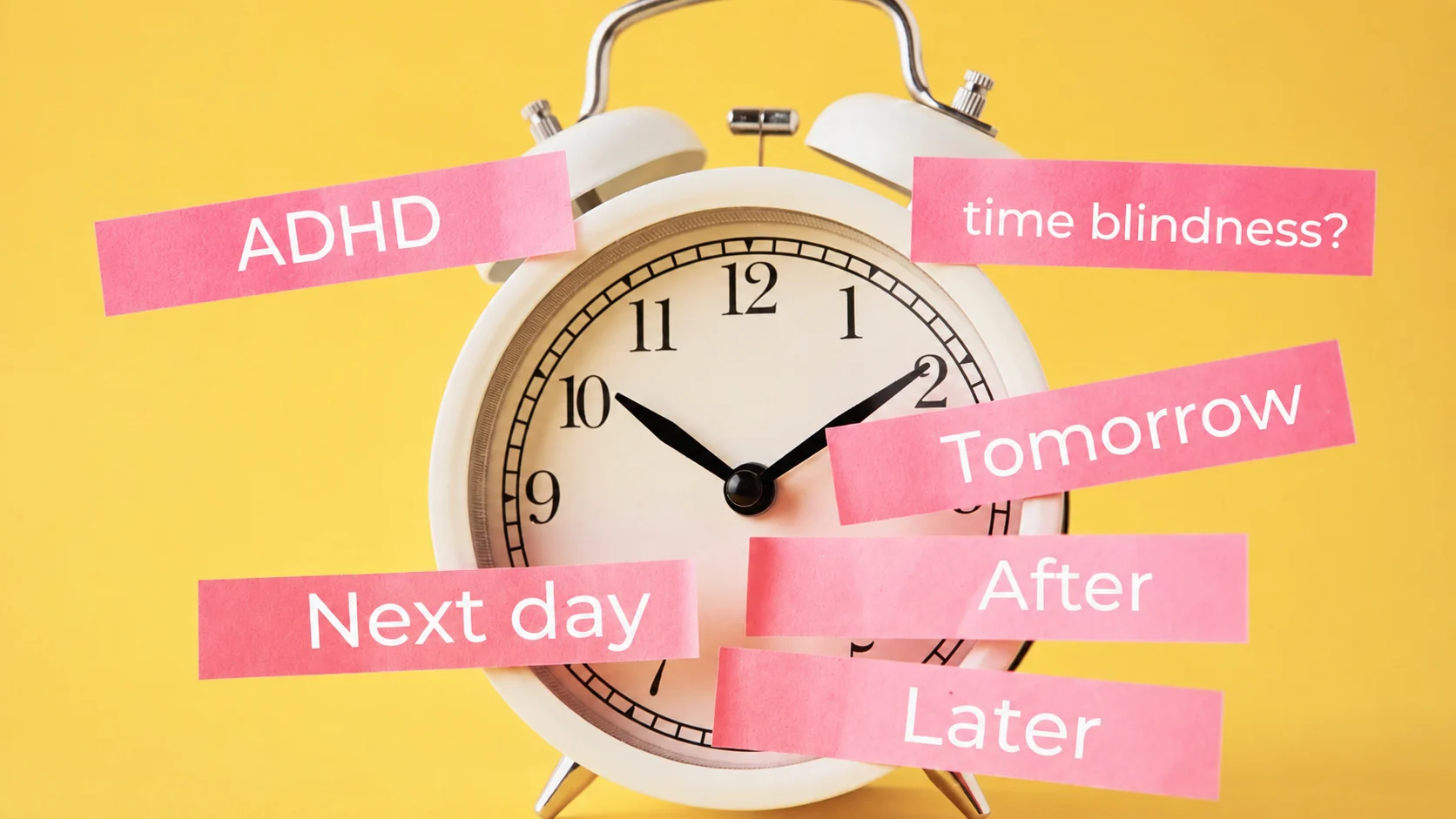
You know that feeling when you genuinely thought you had plenty of time?
You have somewhere to be at 10 a.m. It’s 8:45, so you sit down for a minute. Maybe you check a message, finish what you were doing, make coffee, look for your keys, or decide you can squeeze in one more little thing. When you finally look at the clock again, it’s 9:37.
And suddenly you’re doing that familiar ADHD maths: If I get dressed in five minutes, find my bag in two, skip breakfast and leave right now…
You knew what time it was. You knew when you had to leave. The frustrating part was that you still didn’t feel how quickly those minutes were disappearing. Or maybe deadlines are your problem.
Something is due in three weeks, so it doesn’t feel urgent enough to start today. You think about it, make a mental note, maybe even promise yourself you’ll get to it tomorrow. Then somehow it’s Thursday night, the deadline is Friday morning, and suddenly you can think about nothing else.
If you’ve ever wondered, Why am I so bad at time when I know perfectly well what time it is?, ADHD time blindness may be part of the picture.
The Note in Brief
ADHD time blindness is an informal term for difficulties with sensing how much time has passed, estimating how long something will take, and judging how close a future event or deadline feels.
It is not a separate diagnosis, and not every person with ADHD experiences it in the same way. But research has found differences in several aspects of time perception in ADHD, while poor time management, planning and organisation are also common challenges for adults with ADHD.
The useful part is this: you don’t have to become naturally good at “feeling” time before you can manage it better. You can make time easier to see, estimate and act on. If you’ve spent years calling yourself “bad at time management,” this note may help you see that the problem isn’t always motivation. Sometimes it’s your brain’s way of experiencing time itself.
In This Note
- What Is ADHD Time Blindness?
- What Does ADHD Time Blindness Feel Like?
- Why Does ADHD Make Time Management So Difficult?
- Why an Hour Disappear So Quickly?
- Why Do Future Deadlines Feel So Far Away?
- ADHD Time Blindness and Procrastination
- How to Manage Time With ADHD as an Adult
- Why Alarms Alone Don’t Always Work
- When ADHD Time Blindness Starts Affecting Everyday Life
- Today’s Life Note
- FAQs
What Is ADHD Time Blindness?
Time blindness doesn’t mean you can’t read a clock.
You can look at the screen and know it’s 4:30. The difficult part can be knowing what 4:30 feels like in relation to everything else you still need to do.
An hour can feel like plenty of time until there are only ten minutes left. A task that sounds like a quick 20-minute job can take an hour. A deadline three weeks away can feel strangely unreal until it becomes tomorrow’s problem.
This is why people often describe ADHD time blindness as having an unreliable internal sense of time.
Some people lose track of time when they’re absorbed in something. Others underestimate how long everyday tasks take. Some struggle more with future deadlines and planning. Some experience several of these at once.
And sometimes it can go in the opposite direction too. A person may become so worried about being late that they arrive extremely early because they don’t trust themselves to judge the time accurately.
The point isn’t that there is one “ADHD way” of experiencing time. It’s that time can be much harder to judge and organize than it looks from the outside.
What Does ADHD Time Blindness Feel Like?
For many adults, it looks less dramatic than the phrase “time blindness” makes it sound.
It’s the shower that was supposed to take ten minutes. The email that was supposed to take five. The quick scroll before getting ready. The one extra thing you decide to finish before leaving. The meeting you were sure you had plenty of time to prepare for.
And then suddenly you’re rushing.
You may find yourself:
- regularly underestimating how long getting ready will take
- losing track of time when you’re interested in something
- looking up from your phone or laptop and wondering where an hour went
- arriving late even though you started getting ready with good intentions
- putting off a deadline because it doesn’t feel urgent yet
- struggling to work out when you should start a task
- spending far longer on something than you expected
- forgetting that transitions between tasks take time too
- becoming so focused on one thing that everything else disappears from your awareness
- relying heavily on alarms, reminders or other people to keep you on schedule
There can also be a particularly frustrating part that doesn’t show up on a calendar.
You may be trying the whole time.
You can be anxious about being late, rushing around the house and still arrive late. That can be difficult to explain to someone who assumes lateness means you didn’t care enough.
It can also make you question yourself. Why can’t I just leave on time? Why do I keep doing this?
Why does everyone else seem to understand how long things take? Those questions can become more exhausting than the missed five or ten minutes themselves.
Why Does ADHD Make Time Management So Difficult?
Managing time isn’t just about knowing what time it is.
You also have to remember what needs to happen, estimate how long it will take, decide when to begin, shift between activities and keep the plan in mind while you’re doing something else.
Those are exactly the kinds of everyday functions that can be difficult for adults with ADHD.
The National Institute of Mental Health lists poor time management, planning and organisation among the difficulties adults with ADHD may experience, along with procrastination, trouble completing large projects and difficulty sticking with daily tasks.
Then there is attention. When something is interesting, rewarding or urgent, it can be much easier to stay with it. When something is boring, distant or difficult to start, the pull can be much weaker.
So the problem isn’t always:
“I don’t know what I should be doing.”
Sometimes it’s:
“I know exactly what I should be doing. I just can’t make that information feel important enough right now.”
That difference matters.
Why Can an Hour Disappear So Quickly?
Think about getting ready to leave the house.
You need to shower, get dressed and find your keys. Then you answer one message, put something away and suddenly remember you haven’t eaten.
None of those things sounds particularly time-consuming, but the clock doesn’t care how small each step feels.
Ten minutes here and ten minutes there still add up to 40 minutes. ADHD can also make it easier to become deeply absorbed in something. During that kind of intense focus, awareness of everything outside the task can fade into the background.
You aren’t necessarily deciding to ignore the clock. You may simply stop noticing it.
ADDitude’s reporting on adults with ADHD describes this familiar experience: people can underestimate travel and task times, become absorbed in an activity and lose awareness of how much time has passed. That’s why “just check the clock” isn’t always a complete solution. If you remembered to check it, you might be fine.
The problem is remembering to check it before the hour disappears.
What Research Suggests
Research supports the idea that time perception can be different in ADHD. A 2022 meta-analysis combined findings from 55 studies and found consistent differences in perceptual timing among people with ADHD, including difficulties with time estimation. Researchers also caution that time perception is made up of several different abilities, so the pattern isn’t identical for everyone.
That matters because the experience of thinking “I swear that only took 20 minutes” may have more behind it than poor planning. For some people with ADHD, judging duration really is harder. External cues such as timers, visible clocks, reminders and structured schedules can therefore be practical supports rather than signs that someone isn’t trying hard enough.
Why Do Future Deadlines Feel So Far Away?
This is where ADHD time management gets especially frustrating.
A deadline next month is real, and you know it’s real. The problem is that it may not feel particularly real today, so getting started can be surprisingly difficult. Tomorrow doesn’t feel urgent either. Then the deadline gets close enough to create pressure, and suddenly the work feels much easier to act on.
This can create a cycle of waiting for urgency to provide the motivation that wasn’t there earlier.
CHADD describes ADHD time-management difficulties as involving planning, prioritising, motivation and organisation, and notes that adults may struggle with procrastination and miscalculating how long tasks will take.
This is one reason a distant deadline can be surprisingly hard to act on. The calendar says three weeks. Your brain may experience not now.
Pause & Reflect
Think about the last time you told yourself, “I’ve still got time.”
Did you actually have enough time, or did it simply feel that way?
That small difference can tell you a lot about where your own time blindness shows up.
ADHD Time Blindness and Procrastination
Time blindness and procrastination often travel together, but they aren’t the same thing. Procrastination is delaying a task.
Time blindness can make it difficult to judge when you need to start, how long the task will take or how much time you actually have left. And one can make the other worse.
You underestimate the task, start later than planned, run out of time and end up rushing.
The task becomes stressful, which makes you even less likely to want to start it next time. Before long, time blindness and procrastination are feeding each other.
This is why simply telling someone with ADHD to “stop procrastinating” can miss the real problem.
Sometimes the better question is:
What makes the task feel possible to start before it becomes urgent?
That question leads somewhere useful.
How to Manage Time With ADHD as an Adult
The biggest change is surprisingly simple:
Stop asking your brain to be the only clock in the room.
If your sense of time is unreliable, give yourself something outside your head to work with.
Make Time Visible
A clock tells you what time it is. A countdown tells you how much time you have left. That difference can matter.
Try a visible timer when you’re getting ready, working, cooking, cleaning or taking a break. You don’t need to stare at it. You just want time to stay present instead of quietly disappearing. CHADD describes this approach as learning to “see” time by externalizing it rather than relying entirely on internal awareness.
Estimate, Then Check
Before starting a familiar task, make a quick guess.
“This will take 20 minutes.” Then time it. Maybe it takes 35. That’s useful.
The goal isn’t to become perfect at estimating time overnight. It’s to collect real information about your own habits.
After a while, you may discover that getting ready usually takes 40 minutes, emails take longer than expected, or cleaning one room somehow always becomes a 90-minute project.
Your own data is more useful than another optimistic guess.
Give Yourself a Start Time, Not Just a Deadline
“Finish the report by Friday” is a deadline. It isn’t a starting instruction.
Try:
Tuesday, 10:00: open the document and work for 20 minutes.
That’s much easier for your brain to act on. Breaking larger projects into smaller pieces with their own due dates is also recommended in CHADD’s guidance for adults with ADHD.
Count the Time Around the Task
This is one of the easiest things to forget. If your appointment is at 10, the task isn’t simply “get to the appointment.”
You have to find your keys. Get dressed. Pack your bag. Put your shoes on. Walk to the car. Find parking. Walk inside.
Every little task needs time to complete. Those minutes count.
If you consistently plan only for the main task, you’ll keep wondering why your schedule never quite works.
Build Buffers Into Real Life
If something regularly takes you 15 minutes longer than you expect, that extra 15 minutes isn’t an accident anymore.
It’s part of the task. Build it in.
A buffer isn’t wasted time. It’s the space between your ideal version of the day and the day that actually happens.
Use More Than One Time Cue
One alarm at 8:30 saying “leave at 9” may not be enough.
Try giving yourself stages:
8:15: Start getting ready.
8:40: Finish up.
8:50: Shoes and bag.
8:55: Leave.
ADHD organisations and specialists often recommend using alarms as more than a final reminder. They can act as transition warnings or check-ins that bring your attention back to the clock before you’re already running late
The goal isn’t to fill your life with alarms. It’s to catch yourself before you are already late.
Try it today
Pick one task you do regularly today. Before you begin, write down your guess.
Say you think the task will take 20 minutes, then start the timer, finish the task, and check the real number. Maybe it took 37 minutes.
Now ask one more question: Where did the extra 17 minutes go?
Maybe the task itself took 25 minutes. Maybe five minutes disappeared between steps. Maybe you checked your phone twice. Maybe you had to find something you hadn’t planned for.
Do this a few times with everyday tasks. You’re not trying to prove that you’re “bad at time.” You’re building a more honest map of how your day actually works.
Why Alarms Alone Don’t Always Work
If you’ve ever set five alarms and still ended up late, you’re not the only one.
The problem usually isn’t that the alarm failed. It’s that an alarm tells you what time it is, but it doesn’t always help you change what you’re doing.
For many adults with ADHD, the alarm goes off while they’re deeply focused on something else. They silence it with every intention of getting up “in just a minute”… and then that minute quietly becomes another twenty.
Sometimes the opposite happens. The alarm goes off too early, your brain thinks, I’ve got loads of time, and suddenly you’re scrolling, tidying one small thing, or answering a message before you realise you’re running late again.
This is why one alarm often isn’t enough.
Many ADHD specialists recommend building layers of external reminders instead of relying on a single alert. For example:
- a “start getting ready” alarm
- a “leave in 10 minutes” reminder
- a final “walk out the door now” alarm
A visible countdown timer can also be useful because the remaining time stays in front of you instead of disappearing after a notification is dismissed. The goal isn’t more alarms. It’s making the passage of time harder to ignore and easier to act on.
When Does ADHD Time Blindness Start Affecting Everyday Life?
Everyone loses track of time sometimes.
It becomes worth paying attention to when the pattern keeps creating problems in your life.
You might notice:
- regularly being late for work, appointments or plans
- repeatedly missing deadlines
- spending much longer on everyday tasks than expected
- rushing through the end of your day
- struggling to plan realistic schedules
- staying up later than planned because you lose track of time
- relying heavily on other people to keep you on schedule
- feeling like you’re constantly catching up
And sometimes the biggest cost is not the missed appointment or late email.
It’s the feeling of not being able to trust your own plans.
If these difficulties are persistent and affecting work, relationships, school or daily life, it is worth discussing the broader pattern with a qualified healthcare professional. Time blindness on its own does not diagnose ADHD, and similar difficulties can have other causes. NIMH notes that adult ADHD is diagnosed from a broader, persistent pattern of symptoms and impairment across areas of life.
Today’s Life Note
Maybe you don’t need to become someone who is naturally good at time. Maybe you need to stop making your brain guess.
Put the timer where you can see it. Give yourself the extra ten minutes you always seem to need. Build your day around what actually happens, not what you wish would happen.
Good time management doesn’t always mean becoming stricter with yourself. Sometimes it means finally making your environment easier for your brain to navigate.
Join the Notes
If you like practical ideas that make room for real life, join The Life Notes.
You’ll get one thoughtful note a week about mental wellness, focus, productivity, relationships and the everyday things we’re all figuring out as we go.
FAQs
What is ADHD time blindness?
ADHD time blindness is an informal term for difficulty sensing how much time has passed, estimating how long tasks will take and judging how close future events or deadlines feel. It is associated with ADHD but is not a diagnosis by itself.
Is time blindness a symptom of ADHD?
Time blindness is not a separate diagnostic symptom in the DSM-5-TR. However, research has found differences in several aspects of time perception and timing in people with ADHD.
Why do I lose track of time so easily with ADHD?
You may become deeply absorbed in an interesting task, underestimate how long something will take, overlook transitions between activities or simply stop noticing the clock while your attention is focused elsewhere.
Why am I always late even when I try not to be?
One reason can be underestimating everything that happens before you actually leave. Getting ready, finding things, switching tasks and travelling all take time. If you only plan around the appointment itself, the schedule can fall apart before you realise it.
How can I manage time better with ADHD as an adult?
Make time external and visible. Try countdown timers, multiple alarms, clear start times, realistic task estimates and buffers. Breaking large projects into smaller steps can also make deadlines easier to act on.
How can I estimate time better with ADHD?
Use an estimate-and-check approach. Guess how long a recurring task will take, time it, and compare the result. Repeating this with everyday tasks can give you a much more realistic personal reference point.
Is ADHD time blindness the same as procrastination?
No. They can overlap, but they’re different. Procrastination involves delaying a task, while time blindness can affect your ability to judge when you should begin or how long the task will take.
Why does a deadline suddenly feel urgent with ADHD?
A distant deadline can feel less immediate until it gets close enough to create urgency. ADHD can involve difficulties with planning, prioritising and delayed rewards, which can make future consequences harder to act on in the present.
Do alarms help with ADHD time blindness?
They can, especially when used as transition warnings or checkpoints rather than only as a final reminder. For example, instead of one alarm telling you to leave, use earlier alarms for starting to get ready, finishing up and leaving.
You Might Find These Helpful
Why Do I Procrastinate Even When I Want to Get Things Done?
A closer look at why important tasks can stay untouched until the pressure becomes impossible to ignore.
How to Stop Feeling Overwhelmed
For those days when every task seems urgent and your brain can’t decide where to begin.
Why Am I Always Mentally Exhausted?
Because managing attention, decisions, responsibilities and everyday life can take more energy than it appears to from the outside.
References
- Meta-analysis: Altered Perceptual Timing Abilities in Attention-Deficit/Hyperactivity Disorder, Journal of the American Academy of Child & Adolescent Psychiatry, 2022.
- Time Perception in Adult ADHD: Findings from a Decade, A Review, 2023.
- National Institute of Mental Health: ADHD in Adults, including information about adult symptoms, planning, organisation and daily functioning.
- ADDitude: Losing Track of Time? 8 Ways to End ADHD Time Blindness, updated 2025.
- CHADD: ADHD and Rarely on Time? It’s Not Just About Time Management, on planning, motivation, procrastination and the experience of being chronically late.
This article is for general information and is not a diagnosis or substitute for professional medical advice. If ongoing difficulties with attention, time or daily functioning are affecting your life, consider speaking with a qualified healthcare professional.
Pingback: ADHD Career Fit: What Career Is Right for Me? (A Realistic Guide) - thelifenotes